Spec-driven development, towards a software factory
Orchard’s approach is spec-driven development: translate business intent into an agreed specification covering scope, constraints, business rules, and observable acceptance criteria. Clients, EKel developers, and AI agents use this shared reference to guide implementation, review, and testing.
The intended delivery loop is specification → scoped tasks → agent-assisted implementation → review and tests → human acceptance → controlled release. When requirements change, update the specification and acceptance criteria, then reassess the affected work and evidence.
The long-term goal is a software factory: a repeatable delivery system that turns approved specifications into tested, reviewable business software. Reusable delivery patterns, agent skills, quality gates, and release evidence can reduce repeated coordination across Salesforce, monday.com, and custom applications. This is a direction of development, not a claim that all platforms are already integrated or delivery is fully autonomous. People remain accountable for priorities, exceptions, acceptance, and release approval.
Business value comes before the tools
A business asks for a better process. What follows is rarely one isolated task: people need to agree on the requirement, understand existing systems, coordinate changes, test the result, and decide when it is ready to use. When those decisions live across conversations, tickets, and separate tools, the hardest question becomes simple: what is actually ready, and what still needs us?
Orchard is an AI agent delivery and operations platform built to make that work visible. It brings business context, solution design, agent execution, human decisions, and release evidence into a shared workspace. AI advances the work; people remain responsible for priorities, judgment, and acceptance.
The value is practical: a clearer connection between a request and its implementation, less context to reconstruct at each handoff, and a shared view of the next decision. These are benefits the workflow is designed to support, rather than promises of a particular percentage saving.
What we have built and used
01 · Salesforce Agentic Delivery
Salesforce provides a concrete example of Orchard in use. The workflow connects business requirements to solution designs, configuration or code changes, review, user acceptance testing, and release records. Teams can follow related data, process, interface, and permission changes as one body of work.
An agent can help inspect a requirement, prepare a design, implement a bounded change, or review the result. Consultants and business owners resolve ambiguity and make acceptance decisions. A completed build, an approved review, a successful deployment, and business acceptance remain separate milestones.
02 · monday.com: bringing the discipline to work management
The next area is work management: turning requests, ownership, status, and approvals into a coherent delivery process around monday.com. The business need is to connect the way a team coordinates its work with the systems that carry it out.
The same Orchard model provides a useful starting point: define the outcome, record the decisions, assign bounded work, and keep validation visible. This is an expansion direction. Specific monday.com connectors and automated actions need to be scoped and verified for each implementation.
03 · AI agentic coding for custom business applications
Some business needs require an application shaped around the work itself: an internal operations tool, a service portal, or a specialized approval flow. Agentic coding brings AI into the implementation process, while professional teams own the architecture, permissions, data behavior, testing, and release decisions.
Orchard’s delivery model is relevant beyond any one platform. A specification becomes bounded work for agents; changes remain inspectable through version control and review; acceptance is checked against the original business scenario. This is the broader application direction, not a claim that every example listed here is already an Orchard deployment.
A high-level architecture, built around accountability
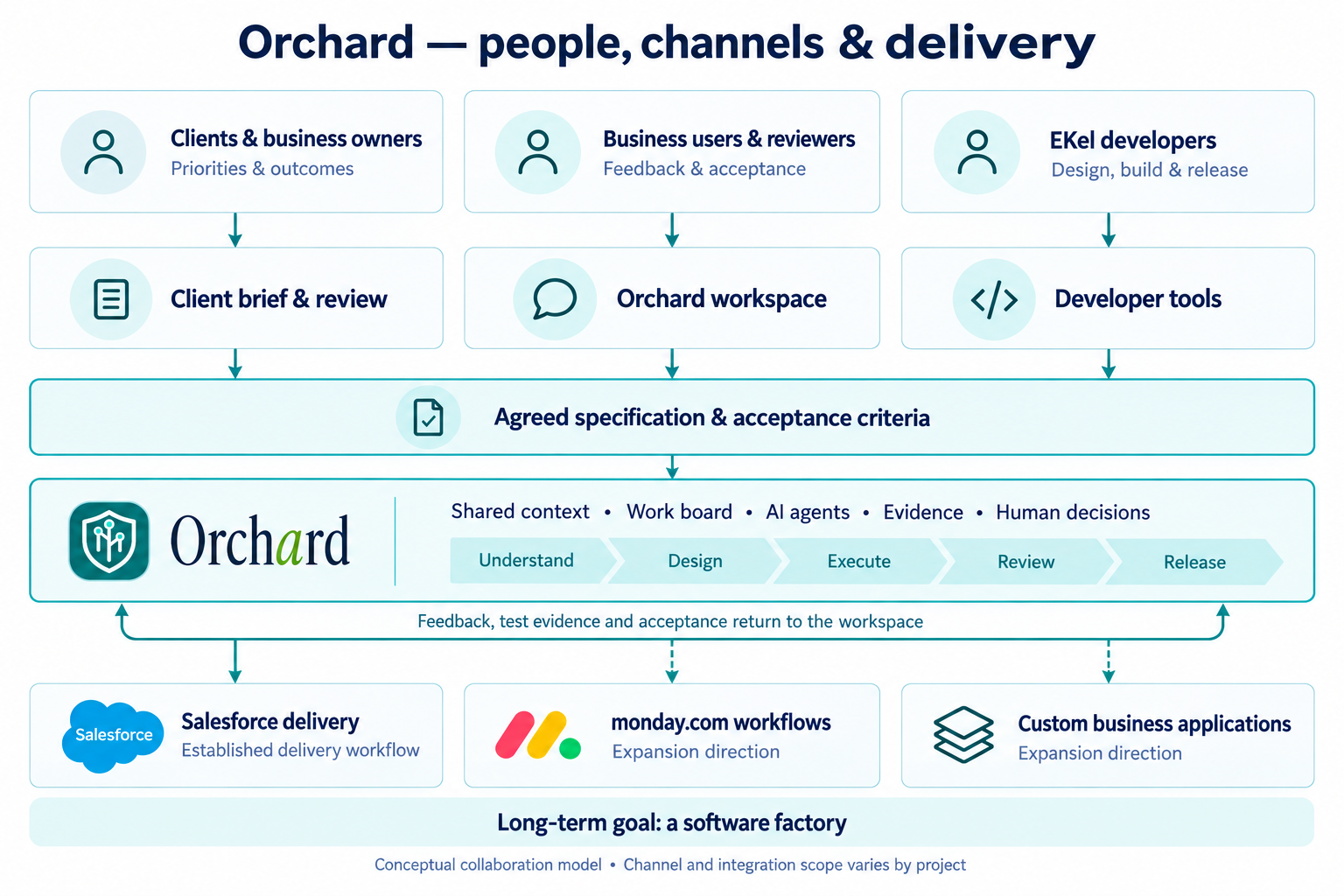
Think of Orchard as the coordination layer between people, agents, and delivery systems. The business team supplies context and acceptance criteria. Orchard organizes the work and its evidence. Agents use scoped skills and tools to execute tasks. Connected systems hold the application changes and environment results. Decisions and findings return to the shared workspace.
The underlying technical needs are consistent: controlled access, project boundaries, durable execution, retrievable knowledge, versioned changes, and observable results. These support continuity when a task spans multiple tools or needs to pause for a person. Platform-specific implementation details stay behind that common delivery model.
What each architecture component does
- People and channels: clients define priorities and acceptance criteria; business users review outcomes; EKel developers translate requirements into a delivery plan. Briefs, workspace discussions, and developer tools connect those responsibilities.
- Specification and shared knowledge: requirement sources, solution designs, and reusable knowledge give agents a common starting point. The agreed specification defines the scope, constraints, and evidence needed for acceptance.
- Delivery coordination: work items, the Agents Board, scheduling, and human decision points connect the stages. A blocker becomes a visible handoff, while execution records explain what happened and what remains.
- Agent execution and tools: agents carry out bounded design, implementation, or review tasks using the relevant skills and tools. The workspace coordinates the work; execution services perform it and return results for inspection.
- Quality, environments, and releases: reviews, automated checks, business acceptance, and environment-specific results provide different kinds of evidence. Release records connect the selected changes to approvals and deployment outcomes.
- Data and platform services: persistent records, file storage, search, background workflows, and monitoring support continuity across sessions. Data preparation can include profiling, mapping, staging, and approval before loading into a target application.
The tools and platforms behind the workflow
The supplied architecture reference identifies the following technology groups. This describes the documented design, rather than a live connectivity audit or a claim that every service is enabled for every project.
- Web workspace — React, TypeScript, and Vite: provide the browser application and shared application types. The workspace gives people one place to inspect context, work, decisions, and results.
- Platform services — Cloudflare: Workers, Workflows, and managed data services support application requests, longer-running tasks, records, files, and knowledge retrieval. Their role is to keep work recoverable and evidence available beyond a single agent session.
- Identity — Clerk: supports sign-in and organization membership. Application permissions and project boundaries determine which work a person or agent may access.
- Engineering — GitHub, Git, and execution tools: repositories, pull requests, reviews, and GitHub Actions connect changes to checks. Node.js and Salesforce CLI support delivery operations; Python-based tools support data preparation.
- Validation — Browserbase, Playwright, and Google Gemini: appear in the documented browser-based QA toolchain. Technical checks support the review process; business acceptance remains a separate human decision.
- Collaboration — Slack and the Orchard workspace: provide notifications, collaboration updates, and points where people can respond. Messages draw attention to work whose context and evidence remain in the workspace.
Platforms we deliver into, and applications we aim to build
Salesforce is the established delivery example: configuration, automation, interfaces, data, and permissions are coordinated through development, acceptance, and release. monday.com is the next work-management direction, where requests, ownership, and approvals need to connect to execution. Custom business applications extend the same spec-driven approach to operations tools, portals, and approval applications. The latter two remain expansion directions in this article; the source material does not establish a completed integration for every example.
For example, a new approval process starts with business rules and acceptance scenarios. EKel turns these into a reviewed specification and bounded tasks. Agents assist with implementation; version control and tests make the changes inspectable; business users confirm the intended behavior; and the release owner authorizes delivery. Repeating that pattern with reusable skills and evidence is the path towards a software factory.
Inside the workspace
See progress and the next handoff
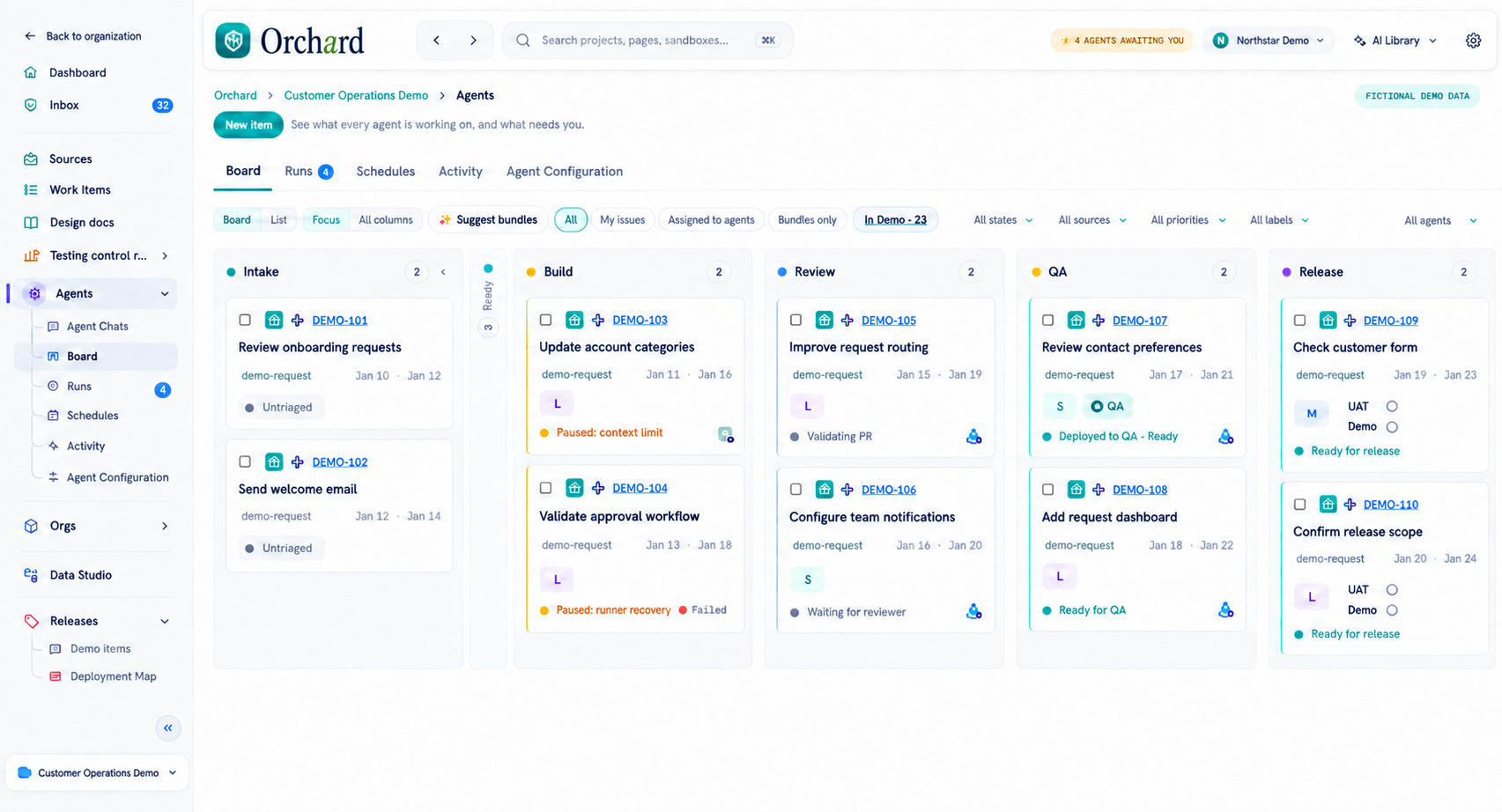
The Agents Board groups work by stage and exposes agent activity in the same view. It helps a team distinguish work in progress from work waiting for review or a human decision.
Keep release evidence connected
Release records bring version preparation, environment steps, validation, and approvals together. A release is not a single green badge: each environment and acceptance step has its own status.
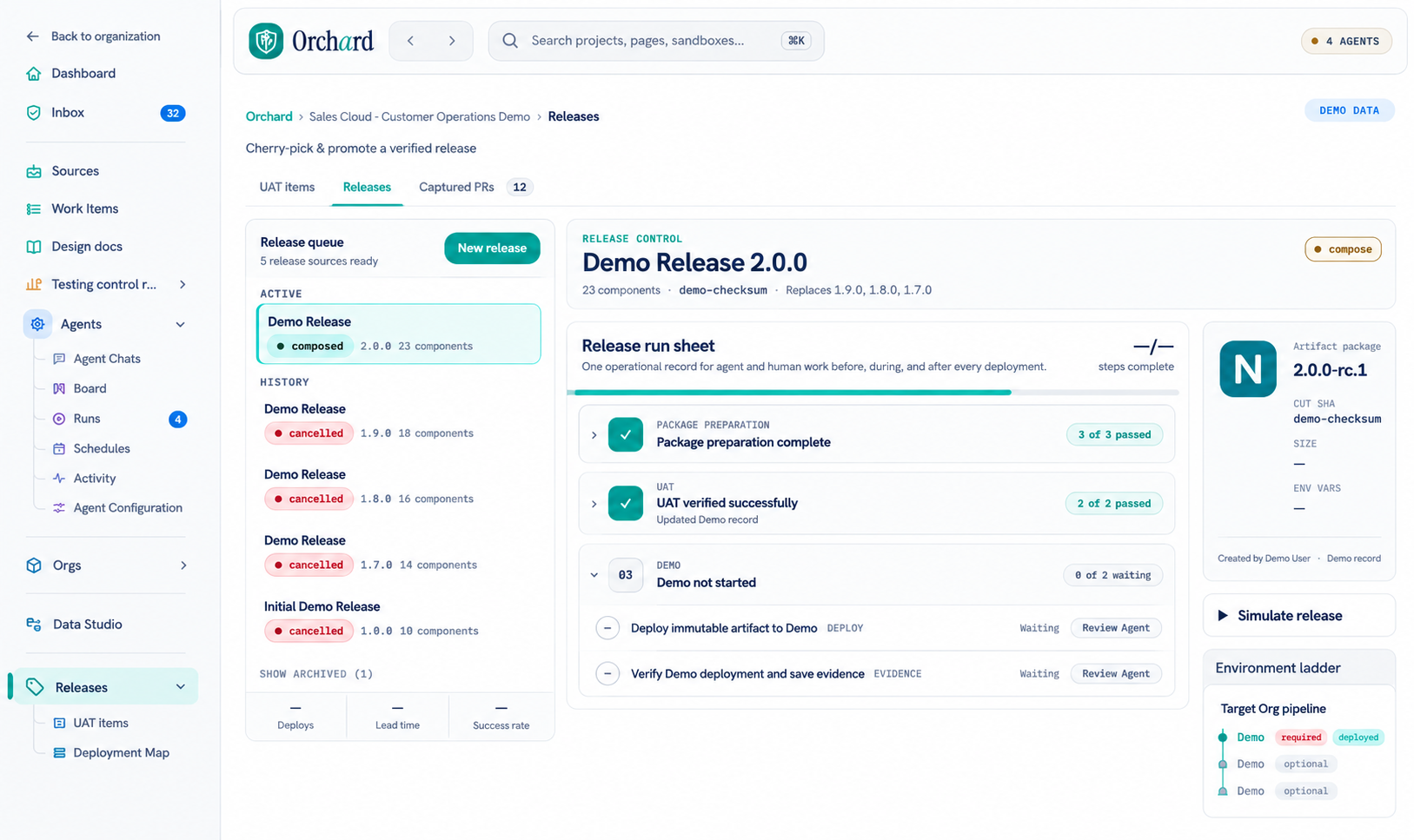
Fresh Orchard captures have been adapted into light-mode demo illustrations using fictional client, system, task, and release details. Small interface details may differ from the originals. All displayed names and records are illustrative; they do not report customer activity or live delivery status.
The functions that make the difference
- Shared context: keep requirement sources, design documents, and knowledge close to the work.
- Coordinated execution: see work items, agent activity, dependencies, and pending handoffs.
- Human decisions: surface questions and sign-offs where an authorized person needs to act.
- Quality and acceptance: connect review findings, test evidence, and business scenarios to the change.
- Traceable releases: retain version contents, environment steps, approvals, and delivery records.
Start with one meaningful business workflow
The best starting point is a real request with a clear owner and an observable outcome. Define what success looks like, identify what needs human judgment, and retain evidence as the work moves forward. Measure lead time, handoff effort, and rework against an agreed baseline.
From Salesforce agentic delivery to work management and custom applications, Orchard’s central idea stays the same: connect business intent to work people can understand, inspect, and accept.
Related Reading
After the Vibe-Coding Hangover: Why Most AI-Built Apps Die Before Go-Live
Vibe coding only took off last year, and the halo barely lasted twelve months. Over the past six months the market's mood has shifted from weekend-app wonder to a harder reality: demos everywhere, systems that survive go-live almost nowhere. This piece breaks down the eight walls between demo and production, why code that "looks right" is the most dangerous kind, and how professional teams using the same AI ship systems that run daily operations — including how we replaced Swingvy in four weeks, full video included.
DIY With AI, Or Hire Consultants? The 18-Month Cost Sheet for Custom Enterprise Apps
AI makes "just build it ourselves" look trivial: two internal engineers, Cursor plus Claude Code, a working demo by week 4. But enterprises don't need demos — they need systems that employees still want to use 18 months later, that audits clear, that don't blow up at the next compliance check. This essay walks the timeline of the DIY-with-AI path — what it looks like at week 4, month 6, month 12, and month 18 — and why the gap between expert and non-expert AI use is the 5–10× output multiplier that decides which path you actually walk.
Agentforce in 2026: An Outsider's 18-Month Field Notes
We haven't shipped Agentforce for a client yet — but we've spent 18 months tracking it. This post compiles failure modes from Western early adopters, Salesforce's platform evolution from Agent Builder to Testing Center to Agentforce Script, and a decision framework with code samples for enterprises preparing to launch in 2026.
Want to discuss your specific scenario?
A 30-minute conversation with a CTA. Based on your situation, we will answer directly: worth doing, too early, or not our fit.
We use cookies
We use strictly necessary cookies to run this site, plus optional analytics cookies (Google Analytics) to understand how visitors use it. See our Cookie Policy and Privacy Policy.